Kansas Boating Laws & Regulations
Know the rules before you ride. Stay safe. Stay legal. Have more fun.
Whether you’re new to the water or have boated for decades, Kansas law applies to everyone. Below are the key statutes and guidelines—especially those that apply to jet ski (PWC) use—with simplified explanations and critical safety highlights.
🛥️ General Kansas Boating Laws
(Applicable to All Motorized Vessels)
📜 Boater Education Requirement
Statute: Any person under the age of 21 who wishes to operate a vessel designed to be propelled by a motor or sail (motorboat, PWC, sailboat, sailboard) without being under direct and audible supervision must complete an NASBLA-approved boater safety course.
Direct and audible supervision is defined as a person on board the same vessel and in sufficiently close proximity of the operator’s station to enable such person to quickly and safely assume control of such vessel if needed. (KSA 32-1125e) The supervising adult must be at least 18 years of age and either have completed a boater education course or be exempt because they are over the age of 21.
In Plain Terms: If you’re under 21 and want to legally drive a jet ski or boat, you need to pass an online boating safety course first to operate a jet ski without either someone 21 years or older OR a adult with a boating license. You can find some of those aproved courses here:
⚓ Required Safety Equipment
Statute: All vessels must have USCG-approved life jackets, a fire extinguisher (where applicable), and a sound-producing device.
In Plain Terms: You must have a life jacket for each person onboard. And for jet skis, the driver and passengers must be wearing it—no exceptions. Jet-skis are also required to have a wistle and a fire exstinguisher on board at all times. All Safety Equipment will be provided to you at the time of your rental through Jet.Set.Go
🚨 Navigation Rules / Right of Way
Statute: Powerboats must give way to sailboats and manually-powered craft (Rowboats, Sailboats, Kyacks, Paddleboards). In crossing situations between two motorized vestles, the boat on the right has the right of way. When two motorized vehicles are aproaching one another head on (Bow to Bow) both vessles should turn to their port side.
In Plain Terms: Just like driving—you yield when you’re supposed to. Jet skis must always operate responsibly and give way if it avoids danger. Like pedestrians while driving a car, non-motorized watercraft always have the right-of-way. When two motorized vehicles approach similar to a 3 or 4 way stop or intersection on the road, the boat to the right has the right-of-way. When two boats are approaching directly towards one another both boats should turn to their starboard side. starboard side is the right side of the boat from the perspective of the drivers position.
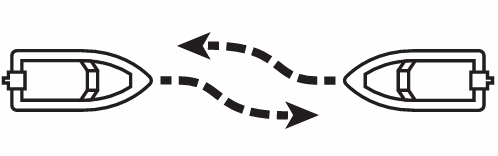
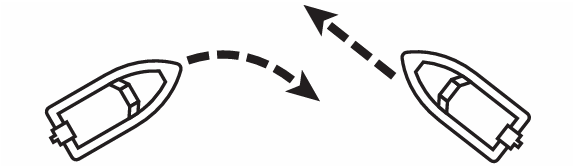
Jet-ski operators should opt, to cross behind a boat when traveling in the same direction to avoid possibly falling off infront of a on-coming vessel. If the boat has a orange flag jup signifying theyre towing a passenger behind them or possibly have somone in the water, more girth than the legal requirment and exercise extra caution and awarness, keeping a eye out for the possibility of people in the water.
🌊 Personal Watercraft (Jet Ski) Specific Laws
👥 Age Restrictions (Reiteration of above Statute)
Statute: Statute: Operators must be at least 12 years old and have completed a boater safety course to ride alone. Operators 21 or older are exempt from the boaters saftey course requirment if they have a valid drivers license.
In Plain Terms: Under 12? No riding solo. Ages 12–20? You need that safety certificate. Ages 12-20 essentially have three scenarios where they may operate the jet-ski:
- A adult 21 years of age or older with a valid drivers license is accompanying them on the jet-ski
- A adult 18 years of age or older that has passed a valid NASBLA approved Boating Saftey Course and posesses said Boater Safety Education Certification is accompaining them on the jet-ski
- Said person aged 12-20 has themselves passed a valid NASBLA approved Boating Safety Course and possesses said Boater Safety Education Certification
💥 Reckless Operation Prohibited
Statute: It’s illegal to weave through boat traffic, jump wakes within 100 feet of another vessel, or operate at high speed in congested areas.
In Plain Terms: No wake-jumping near other boats. No donuts around your friends. No splashing your friends or other boats with your jet-ski. Keep the thrill within safe, respectful boundaries.
📏 Distance Laws
Statute: PWC must stay at least:
-
100 feet from any anchored or moored vessel
-
200 feet behind boats towing skiers or tubers
-
100 feet from docks, ramps, or swimmers
In Plain Terms: Don’t buzz by the dock or whip near swimmers. Keep way back from anyone towing, or you risk serious injuries and fines.
🌊 No Wake Zones
Statute: Must idle at “no-wake speed” (typically under 5 mph) in all posted areas and within 200 feet of shorelines, marinas, docks, and ramps.
In Plain Terms: If you see a buoy or sign for “No Wake”—slow down! That means idle speed only. No speeding up near the shore. The jet-skis Jet.Set.Go rents out idle at speeds nearing 5 mph. That means in a no wake cove, or a cove with boats or swimmers tied up or anchored, give no throttle.
 NEED-TO-KNOW: Jet Ski Safety Laws Summary
✅ 200-Foot Rule
Always stay at least 200 feet away from:
Boats towing people (skiers, tubers, wakeboarders)
Any shoreline unless you’re heading straight out or in
Marinas, docks, and launching ramps
- Boats tied up or anchored within a cove
✅ No Wake Means No Wake
If your jet ski is creating a visible wave, you’re going too fast in a No Wake Zone. These areas protect other boaters, swimmers, and shoreline property.
✅ Kill Switch Required
You must have the engine cut-off lanyard attached to your wrist or life jacket while operating.
✅ Don't Ride After Sunset
Jet skis are not allowed to operate between sunset and sunrise. Period. No lights = no visibility.
✅ Alcohol & Boating Don't Mix
Just like driving, boating under the influence (BUI) is illegal and dangerous. Don’t drink and ride.